Clean Data Is the Foundation of Scalable Revenue
Why marketing data engineering, not campaign optimization, is the key to predictable revenue growth
Many organizations invest in marketing programs, automation platforms, and artificial intelligence, yet still struggle to achieve predictable revenue growth. Executives often assume the issue is campaign performance, creative execution, or channel allocation. However, the root cause is often more fundamental: a data problem. Success depends not just on having data, but on having clean, structured, and connected marketing data that supports revenue decisions throughout the funnel. Without this foundation, growth is fragile. With it, growth is scalable.
Revenue Accountability Requires Data Integrity
Today’s CMO or VP of Marketing is responsible for more than pipeline volume. They are expected to deliver measurable revenue contribution, reliable forecasting, and defensible attribution, all of which require clarity across systems. Clear attributionrelies on consistent lifecycle definitions. Accurate forecasting depends on clean object relationships in the CRM. Executive confidence is built on alignment between marketing, sales, and finance data. When marketing data is fragmented or poorly defined, reporting shifts from analysis to reconciliation. Attribution turns into debate rather than serving as a strategic tool. Forecasts fluctuate not due to performance changes, but because definitions change. This erodes trust, which in modern marketing is fundamentally a data issue.
Data Is Infrastructure, Not Output
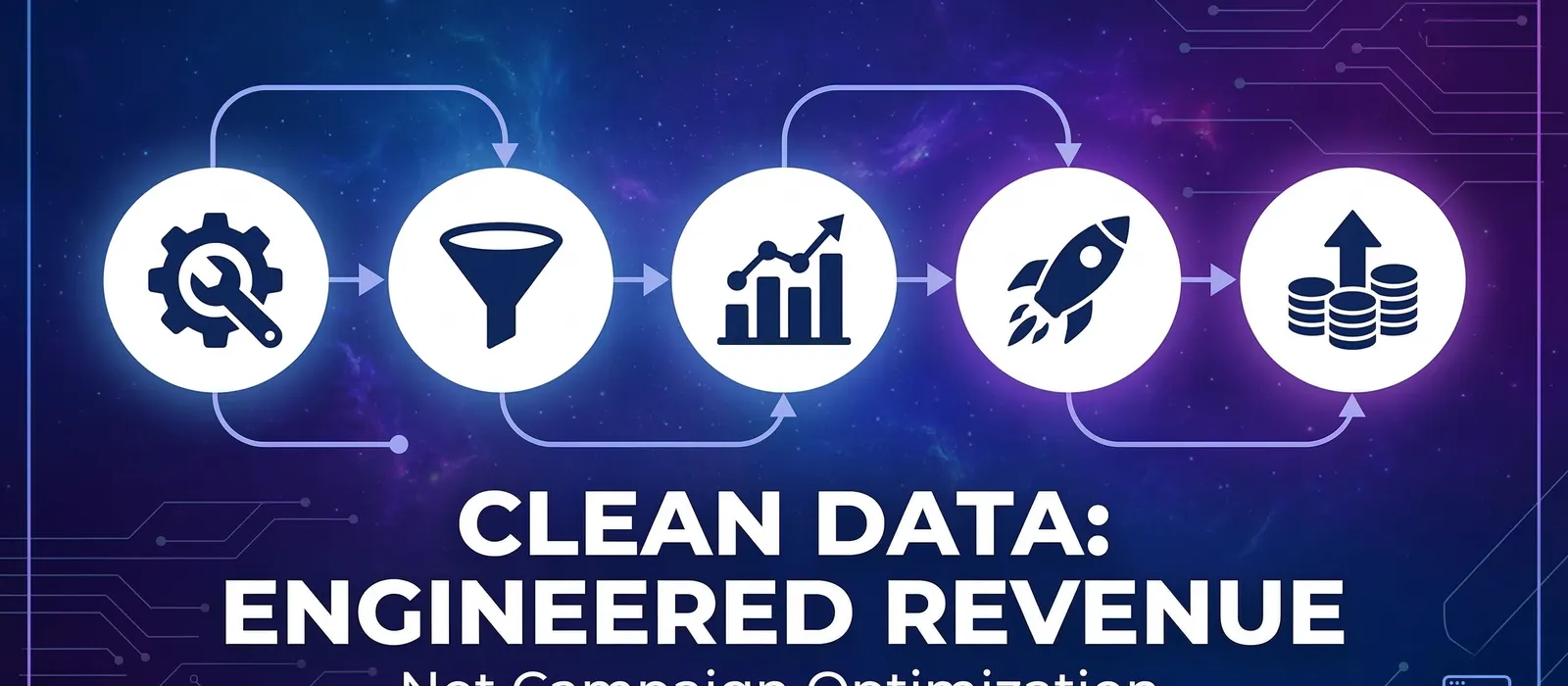
Many companies treat data as a campaign output, generating reports, refreshing dashboards, and reviewing metrics in meetings. From an engineering perspective, data is infrastructure. Infrastructure must be intentionally designed to support every subsequent layer. Properly engineered marketing data enables campaign performance evaluation within a coherent lifecycle framework, ensures attribution models reflect buyer behavior rather than platform bias, supports consistent automation workflows, and allows AI systems to operate on validated inputs. Without this engineering, each new initiative adds complexity, making the system more fragile as it grows.
The Full-Funnel Attribution Myth
Full-funnel attribution is often seen as a tooling problem, with the belief that a CRM, marketing automation platform, analytics tool, or ad network can provide a complete solution. In reality, this expectation is unrealistic. No single platform can solve full-funnel attribution because each captures only part of the customer journey. Ad platforms measure impressions and clicks, analytics tools track sessions and events, marketing automation platforms capture engagement and form activity, and CRM systems record opportunities and revenue. These systems were not designed to operate as a unified revenue architecture. Without normalization, identity resolution, standardized lifecycle governance, and structured naming conventions, attribution relies on fragmented inputs. Attribution debates are common not due to politics, but because of architectural gaps. When marketing leaders experience tension around attribution, it is often because the system was not engineered to deliver unified insights.
Why Engineering Matters
Marketing now spans multiple platforms, channels, and data streams. Paid media, SEO, content, automation, sales engagement, and product signals all generate events, with each system defining and measuring engagement differently. Engineering brings structure to this complexity by asking key questions: What is the authoritative source for each revenue object? How are lifecycle stages defined and governed? How is identity resolved across channels and devices? Where does data transformation occur? How are naming conventions standardized across systems? These are not minor operational details; they determine whether revenue reporting is reliable or reactive. In many mid-market environments, tools are added incrementally, integrations are configured as needed, and reporting evolves over time. While this reflects natural growth, incremental integration is not the same as intentional architecture. Over time, small inconsistencies create significant friction.
The Executive Cost of Fragmented Marketing Data
For a CMO, the cost of fragmented data is strategic, not technical. Sales questions the marketing-sourced pipeline when definitions do not align. Finance challenges forecasts when attribution logic shifts. Leadership hesitates to invest when reporting lacks cohesion. Even strong performance can be undermined if results are not defensible. Marketing may work harder, but executive confidence does not increase proportionally. In our experience, when confidence stagnates despite effort, the root cause is almost always data integrity.
Clean Data Enables Scalable Revenue
When marketing data is intentionally engineered, the impact is measurable throughout the organization. Attribution becomes actionable, allowing leaders to see contribution patterns across channels without last-click bias. Automation is reliable as lead routing, scoring, and lifecycle progression follow aligned definitions. Artificial intelligence delivers value because predictive models and generative tools depend on input quality; clean data enables meaningful insights, while fragmented data creates noise. Forecasting also stabilizes, as revenue projections based on unified signals are more defensible than those built from disconnected reports. This is true scalability: not just more pipeline, but a predictable pipeline supported by structured data.
Marketing Data as a Strategic Asset
When marketing data is treated as infrastructure, marketing shifts from a demand engine to a revenue intelligence function. Instead of asking “How many leads did we generate?” organizations begin to ask deeper questions: How does demand convert across stages? Where does friction occur? Which signals predict revenue? These questions can only be answered when systems are intentionally engineered. This is why we call our approach Engineered Marketing. It is not a slogan; it reflects the belief that revenue systems require architectural thinking and that marketing performance depends on system design.
If Revenue Feels Unstable
If revenue feels unpredictable, the issue may not be creative, channel, or messaging related. It may be a data engineering issue. Clean marketing data may not generate immediate excitement or visibility, but it determines whether growth compounds or collapses under complexity. Organizations that treat marketing data as structured infrastructure scale with confidence. Those that treat it as an output struggle to maintain clarity as complexity grows. Scalable revenue is built on clean, engineered systems, not dashboards alone. That foundation is where real leverage begins.