In many mid-market B2B organizations, revenue operations isn’t a formal team.
There’s no RevOps org chart. No dedicated leader with “RevOps” in their title. Sometimes, the term feels like something only larger companies with eight-figure ARR can justify. And yet, revenue operations are happening every day. Badly.
They show up in how leads are routed or misrouted, and how attribution is debated or weaponized, how the pipeline is forecasted or fabricated, and how confidence in the numbers erodes until the Monday morning leadership meeting becomes a weekly exercise in creative interpretation.
Whether you call it RevOps or not, there is an operating system governing how revenue moves through your business. The question is whether it’s intentional or held together with duct tape and good intentions.
If GTM Is the System, RevOps Is the Operating System
In our previous post on Go-To-Market Engineering, we talked about growth as a system, not a series of campaigns.
RevOps is the layer that makes that system usable.
If go-to-market defines how growth should work, RevOps defines how it actually runs day to day, across tools, teams, and data.
Think of it this way: your GTM strategy might call for a seamless handoff from marketing-qualified lead to sales conversation. But if “marketing-qualified” means one thing in HubSpot, something different in your sales team’s heads, and something else entirely in the board deck, you don’t have a handoff. You have a game of telephone.
RevOps is the operating system beneath marketing, sales, and success. Like any operating system, when it’s unstable, everything built on top of it crashes more often than anyone wants to admit.
You Don’t Need a RevOps Team to Have RevOps Problems
This is the part most mid-market companies get wrong.
They assume RevOps is a maturity milestone, something you graduate into once you’ve hit a certain scale. So they defer the thinking, patch the gaps, and wonder why every quarter feels like they’re rebuilding the plane while flying it.
Most organizations we work with don’t suffer from a lack of effort or intent. They suffer from a lack of coordination. The people are working hard. The system is working against them.
Common signs:
- Marketing reports 4.2x pipeline coverage. Sales says it’s closer to 2.8x. Both are pulling from the same CRM. Neither is wrong-they’re just using different definitions of “qualified” and different timeframes, and nobody wrote down which one is official.
- Attribution becomes a territorial argument instead of a strategic input. Marketing claims the webinar influenced 40% of closed-won deals. Sales says those deals were already in play. The truth lies in the middle, but without an agreed-upon model, the conversation generates heat rather than light.
- Dashboards multiply like rabbits. There are six versions of the pipeline report, three people maintaining them, and zero consensus on which one the CEO should trust on Thursday.
- Every new channel or campaign adds friction. Launching a LinkedIn ABM program shouldn’t require three weeks of Slack threads about how to tag the leads, but it does because nobody designed the taxonomy to accommodate growth.
These aren’t marketing problems or sales problems. They’re operating system problems.
In the mid-market, they almost always land on the desk of the marketing leader, whether that’s fair or not.
Why Marketing Is the Front Door to RevOps
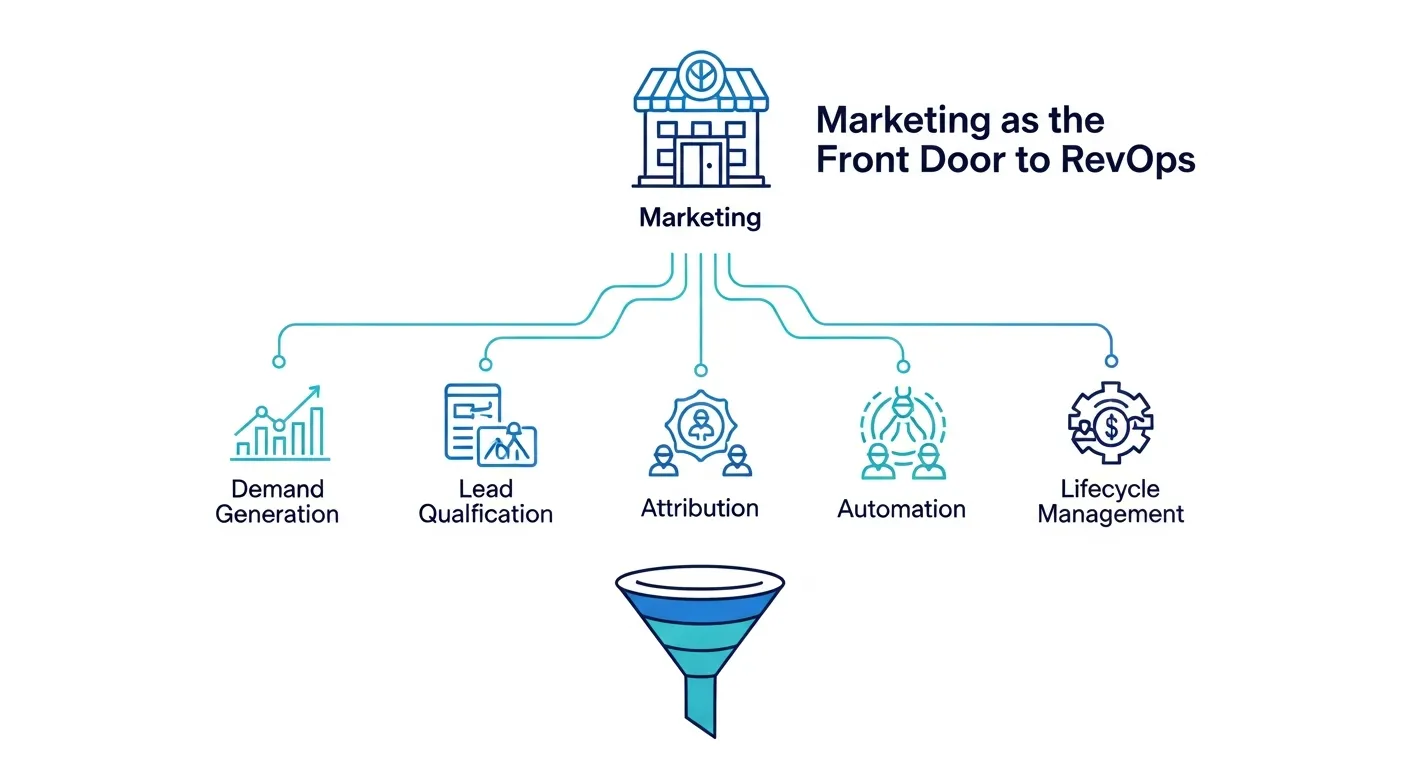
In practice, marketing is where RevOps breaks first. Not because marketing is doing anything wrong, but because it sits at the top of the funnel and touches the most systems.
Marketing touches demand generation, lifecycle definitions, lead qualification, attribution and measurement, and automation and orchestration.
When these inputs are fragmented or loosely defined, the impact cascades downstream, and it compounds.
Here’s a scenario we see constantly: A marketing team defines an MQL as “downloaded two pieces of content and visited the pricing page.” Reasonable enough. But sales have never formally agreed to that definition. When those MQLs convert at 8% instead of the 15% sales expect, the narrative becomes “marketing sends us bad leads” when the real problem is that no one is aligned on what a good lead looks like in the first place.
Sales loses confidence. Forecasts become reactive. Leadership asks for clearer answers that the system can’t reliably provide. The marketing leader, who is already running campaigns, managing a team, and reporting to the board, now has to moonlight as a data architect, process designer, and interdepartmental diplomat.
This isn’t a failure of marketing execution. It signals that marketing has become the de facto owner of revenue operations without the tools or mandate to engineer it properly.
Fragmented Data and Attribution Are Symptoms, Not the Disease
When teams struggle with RevOps, the conversation almost always starts with tools:
- “The CRM isn’t clean.”
- “Attribution doesn’t make sense.”
- “The analytics don’t match.”
Those are real problems, but they’re downstream symptoms. Treating them in isolation is like reorganizing your filing cabinet when the real issue is that nobody agreed on what goes in which drawer.
The root issue is that revenue systems were assembled incrementally instead of designed intentionally. Every tool was added to solve a specific problem at a specific moment. Reasonable at the time. But after three years, you don’t have a tech stack, you have a tech pile.
Data lives in multiple places. Definitions drift. Attribution models are bolted on after campaigns launch, which means they’re measuring what’s easy to track rather than what actually matters. Reporting becomes an exercise in reconciliation rather than insight. Your team spends Friday afternoon making the numbers agree rather than making them better.
Here’s a telling diagnostic: ask your marketing, sales, and CS leads to independently define “pipeline” and “revenue-qualified”. If you get three different answers, and you probably will, that’s not a people problem. That’s an architecture problem.
Without a coherent operating system, every decision requires more effort than it should, and every answer comes with an asterisk.
RevOps as an Operating System, Not a Department
This is where reframing RevOps matters.
RevOps doesn’t have to start as a team. It starts as an architecture, a set of agreed-upon definitions, data flows, and rules that make the revenue engine legible to everyone who depends on it.
An effective RevOps operating system does four things:
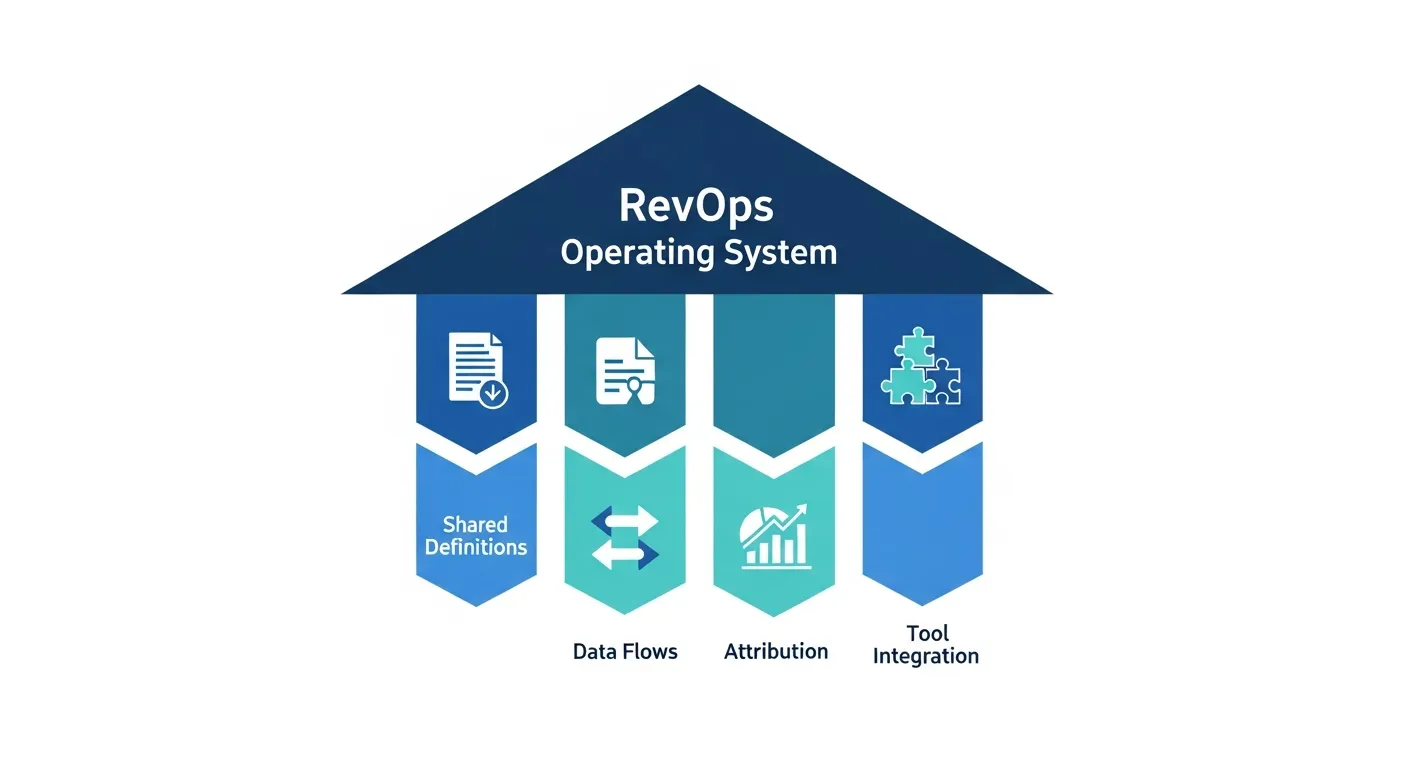
It establishes shared definitions for lifecycle stages.
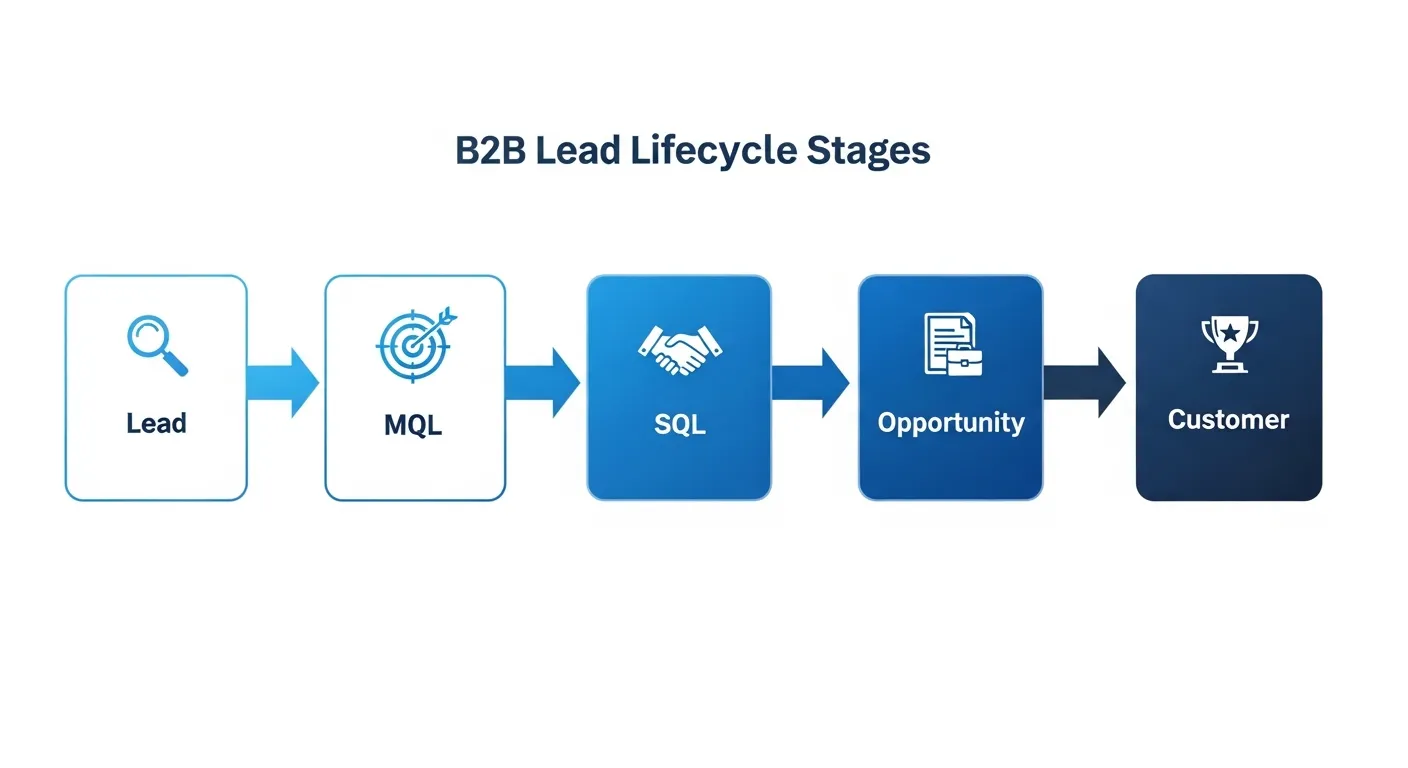
Not just “MQL” and “SQL”, but what specifically qualifies a lead at each stage, who owns the transition, and what happens when a lead stalls. Write it down. Make it boring. Boring is stable.
It creates consistent data flows across marketing, sales, and success.
When a lead converts to an opportunity, every system should reflect that change simultaneously. If your marketing automation platform and your CRM tell different stories about the same contact, you don’t have a data flow; you have a data fork.
It aligns attribution with how decisions are actually made.
Multi-touch attribution is only useful if the touches you’re tracking correspond to the moments that actually move buyers forward. Most attribution models over-index on first touch and last touch while ignoring the messy middle: the peer referral, the champion’s internal pitch, the competitive teardown that arrived at exactly the right moment.
It reduces friction between tools instead of adding to it.
Every integration should make the next action easier, not require a workaround. If your team has a shared Google Doc explaining how to get around a particular system limitation, that limitation is costing you more than you think.
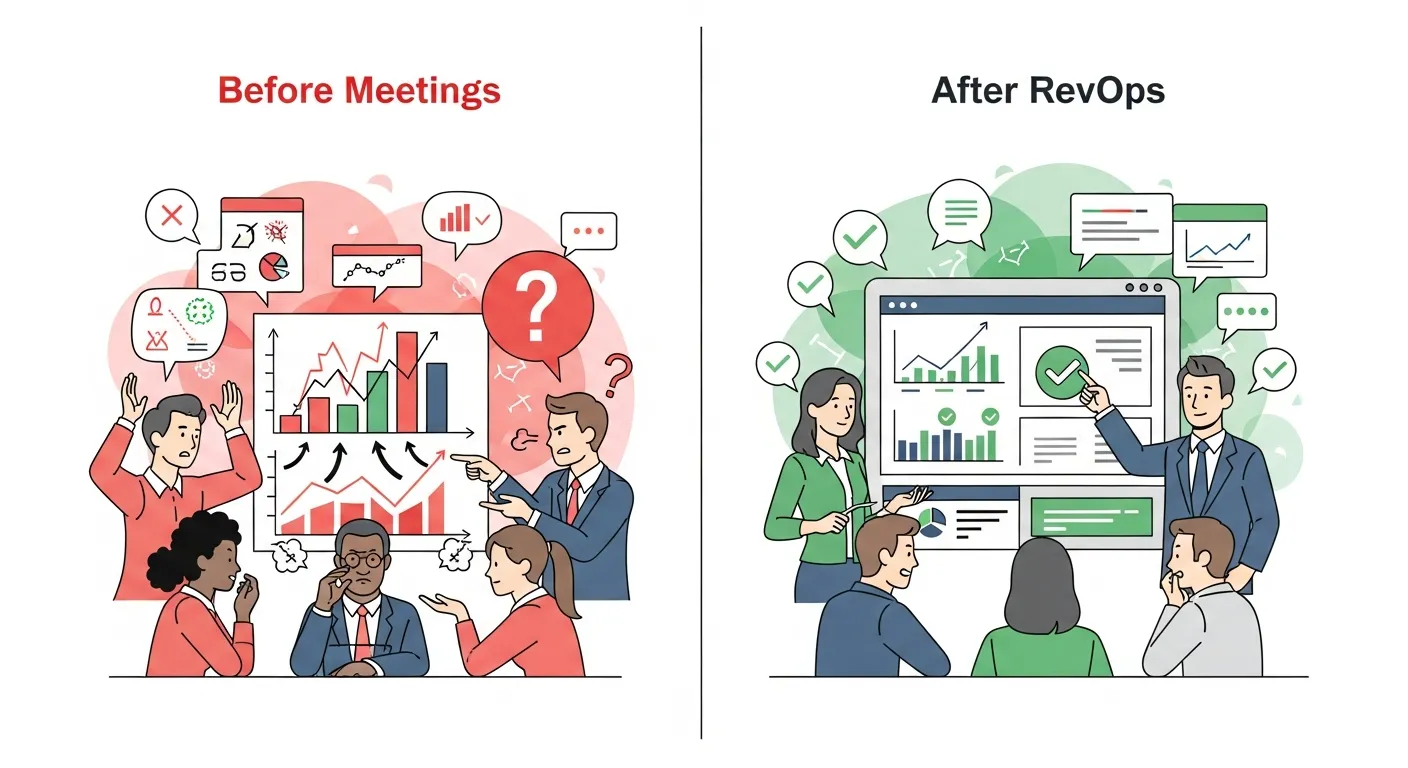
When this foundation is in place, execution speeds up. Confidence improves. Teams stop debating numbers and start acting on them. The Monday meeting becomes about decisions instead of definitions.
The Role of a GTM + RevOps Bridge
For many mid-market teams, building this operating system internally isn’t realistic all at once.
Marketing leaders are already responsible for growth. Sales needs results this quarter, not next.
Hiring a full RevOps team, a director, a systems admin, and an analyst might cost $350K+ fully loaded, and you may not need that level of permanent investment. You need the thinking and the architecture, not necessarily the ongoing headcount.
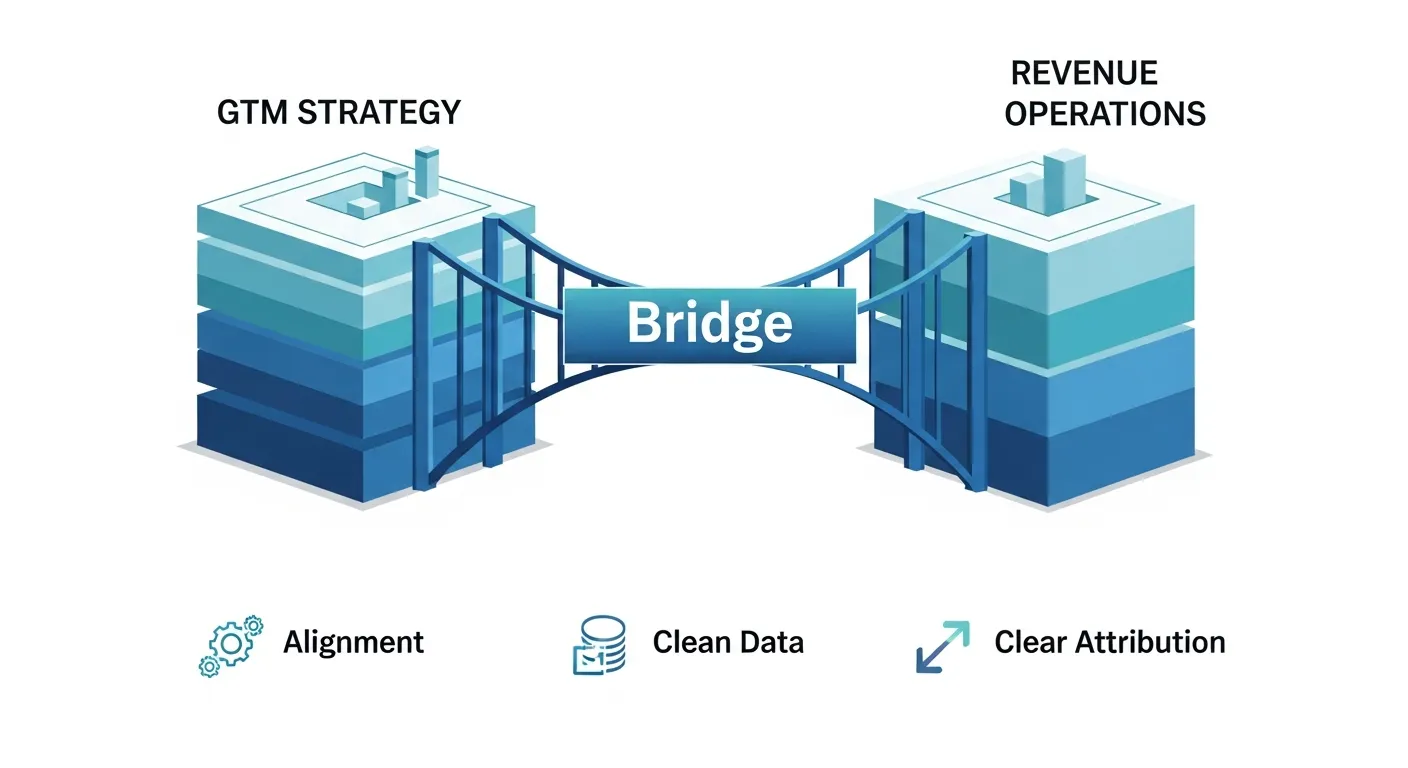
This is where a GTM + RevOps bridge becomes valuable.
Instead of adding headcount, the focus shifts to designing the revenue operating system, aligning marketing-led inputs with downstream revenue needs, implementing structure where fragmentation exists, and creating clarity without slowing execution.
Done well, this bridge work pays for itself quickly. When pipeline definitions are shared, forecast accuracy improves. When attribution is intentional, budget allocation gets sharper. When data flows are clean, the team that used to spend 10 hours a week on reporting spends 2, and the reports are trusted.
The goal isn’t bureaucracy. It’s removing the invisible tax that fragmentation puts on every revenue decision your team makes.
RevOps Enables Marketing to Do Its Job Better
When RevOps is engineered, even informally, marketing becomes measurably more effective.
Campaigns are evaluated in context, not in isolation. Attribution supports prioritization rather than just justification. Data tells a coherent story that the whole leadership team can read. Growth decisions get clearer because the inputs are trustworthy.
Most importantly, marketing regains credibility as a revenue driver, not just a lead source. That shift matters, not just for the marketing leader’s standing in the room, but for how the entire organization thinks about where growth comes from.
Engineered Marketing, Applied to Revenue Operations
At Axiolo, we approach RevOps the same way we approach go-to-market strategy: as an engineering problem with a design solution.
We work with mid-market B2B teams to bridge GTM strategy and revenue operations, often starting with marketing as the entry point, because that’s where the pain is most visible, and the leverage is highest.
Our focus is not on building a RevOps department, but on designing and implementing the operating system that supports revenue. In practice, we help teams reduce fragmentation between tools and data, resolve attribution arguments with intentional design rather than louder opinions, align marketing execution with revenue outcomes, and build systems that scale without adding unnecessary complexity.
If RevOps feels out of reach, that doesn’t mean you need to hire a full team. It means you need to start by deliberately engineering the system, with shared definitions and a clean architecture, not another dashboard and a prayer.
If you’re exploring how to strengthen revenue operations without adding headcount, let’s map what that foundation looks like for your team.