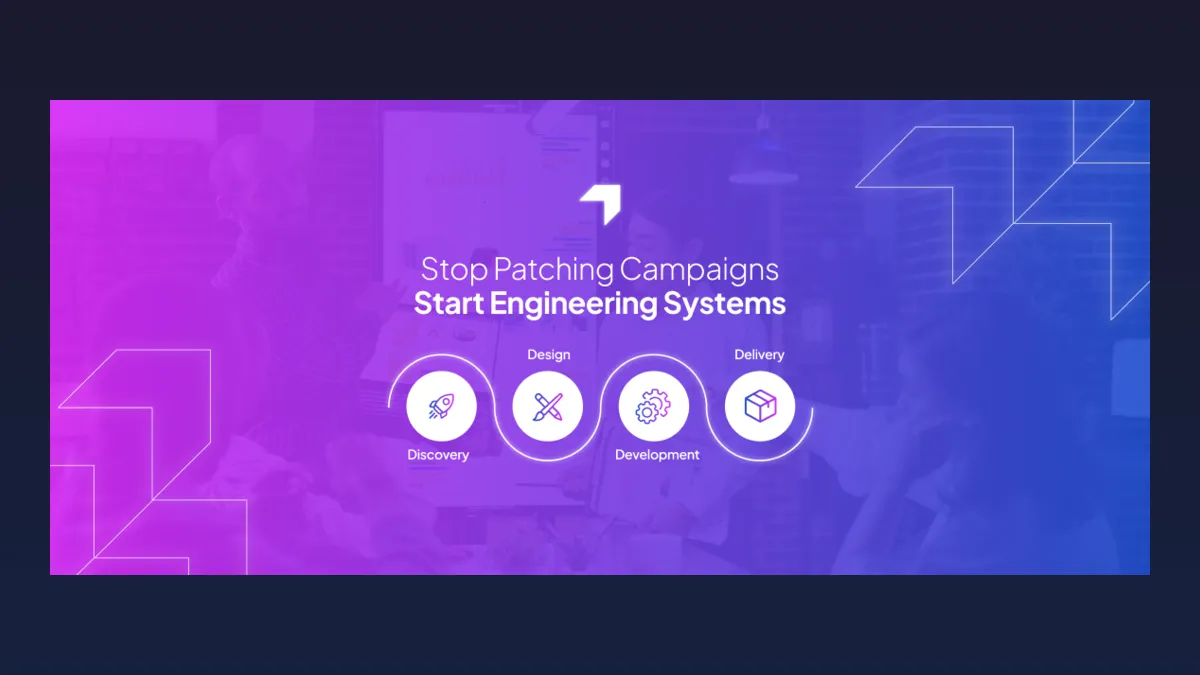
If you lead marketing or revenue at a mid-market B2B company, this probably sounds familiar:
Your team is shipping campaigns. Tools are in place. Dashboards are full. Yet growth feels harder than it should. Does it seem like you’re burning too many Resources, losing Time to market, or sacrificing the Flexibility to pivot? The pipeline is inconsistent. Attribution is debated more than trusted. Every new initiative seems to add complexity instead of momentum.
That doesn’t mean your strategy is off track.
More often, it means your go-to-market system wasn’t built to scale.
This is where many modern GTM efforts quietly break down, not because teams lack creativity or effort, but because the system underneath can’t handle the pressure.
Growth Doesn’t Fail Because Teams Aren’t Trying
Most marketing and revenue leaders we meet are already doing a lot.
They run demand programs, invest in SEO, add paid media, set up automation, test AI, support sales, and report to leadership.
The issue isn’t a lack of activity. The problem is that these activities operate as disconnected parts rather than working together as a single system.
Campaigns launch without shared definitions. Data gets pieced together later. Attribution becomes a debate rather than a decision-making tool. When something underperforms, the instinct is to add another campaign or tool. This cycle is exhausting, but it’s not about poor leadership. It shows the GTM model was built for a simpler time.
Why Traditional GTM Models Stop Working
Most go-to-market motions were built around a few core assumptions:
- Buyers move linearly through a funnel.
- Channels can be optimized independently.
- Data can be cleaned and reconciled later.
- Campaigns are the primary growth lever.
Those assumptions no longer hold.
Modern B2B buying journeys are fragmented and non-linear. They’re shaped by factors outside your control, like AI-driven discovery, long-tail content, peer validation, and product signals. When GTM is run as siloed campaigns, teams experience familiar symptoms: - Inconsistent lead quality
- Manual handoffs between marketing, sales, and CS
- Conflicting reports and attribution models
- Lifecycle stages that mean different things to different teams
- Growing operational debt
Once you reach a certain scale, better execution won’t solve these problems. The right architecture will.
Introducing Go-To-Market Engineering
Go-To-Market Engineering offers a new way to think about growth.
It treats GTM as a system that needs to be designed, built, and maintained - not just a set of tactics.
In practical terms:
Go-To-Market Engineering uses engineering discipline, systems thinking, architecture, feedback loops, and strong data quality to drive revenue.
It is not:
- A new tool
- A rebrand of RevOps
- A replacement for strategy or creativity
- A push to automate everything
It is:
- Designing workflows before automating them
- Treating data as infrastructure, not exhaust
- Aligning teams around shared definitions and signals
- Building systems that improve over time, not ones that constantly need patching
The Core Principles of GTM Engineering
1. Systems Over Campaigns
Campaigns are outputs, but systems are assets that grow in value over time. A well-designed GTM system makes every campaign more effective.
2. Architecture Before Automation
Automation makes what you already have bigger. If workflows aren’t clear, automation just spreads confusion faster.
3. Data as Infrastructure
Clean, consistent data isn’t just a nice extra for reporting. It’s what lets you prioritize, personalize, and predict.
4. Feedback Loops by Design
Learning shouldn’t only happen once a quarter. GTM systems should always capture signals and adapt to them.
What This Looks Like in Practice
An engineering-first GTM doesn’t mean rigid processes or slow execution. In fact, it usually speeds things up.
When systems are designed intentionally:
- Lifecycle stages are defined once and used everywhere.
- Intent and engagement signals inform both marketing and sales actions.
- Attribution supports decision-making rather than vanity reporting.
- Channels like SEO, paid, outbound, and product all work together instead of being siloed. The result isn’t just cleaner operations. You also get faster decisions and more confident execution.
Why This Matters Now
AI is speeding up everything, including both progress and problems.
Teams are using AI for content, targeting, scoring, and forecasting. But AI can’t fix broken systems. It relies on them.
Bad data leads to bad recommendations. A fragmented GTM gives you unreliable insights. Automation without the right architecture is risky.
AI doesn’t fix broken go-to-market systems. It makes their problems more obvious.
Organizations that treat GTM as an engineered system are better prepared to use AI responsibly and effectively, because their foundations are solid.
The Role of an Engineering-First GTM Partner
This is where many teams run into a real challenge.
You might see the need for better GTM architecture, but rebuilding systems while running the business is tough. Internal teams are busy, and hiring full-time specialists for every layer isn’t realistic.
An engineering-first GTM partner can help fill that gap.
The right partner does more than launch campaigns or set up tools. They help you:
- Design a GTM architecture that fits your business.
- Align data, workflows, and teams.
- Implement systems that scale with growth.
- Reduce operational drag rather than adding to it.
Engineered Marketing, by Axiolo
At Axiolo, we see growth as an engineering problem because at scale, that’s what it becomes.
We’re an Engineered Marketing company and a GTM partner. We work strategically with mid-market B2B teams that need systems, not shortcuts.
Our work sits at the intersection of:
- Go-to-market strategy
- Revenue operations
- Data architecture
- Search, discovery, and attribution systems.
We help teams design and build GTM systems that are intentional, resilient, and ready for what’s next. Your growth feels harder than it should. It’s worth asking a simple question:
Is your go-to-market system engineered or improvised?
If you’re ready to take an engineering-first approach to growth, reach out to Axiolo to build GTM systems that scale.